Index
The pull-up is the most honest exercise in the world. It doesn't lie and it won't let your ego cheat. If you can pull yourself up, you can do it; if you can't, you have work ahead.
This 8-week program is built to take a healthy person from zero reps to around 10 strict pull-ups. No shortcuts and no magic supplements: an ordered progression, three base exercises, and one non-negotiable rule — every week you have to do slightly more than the last one.
Starting Point Assessment
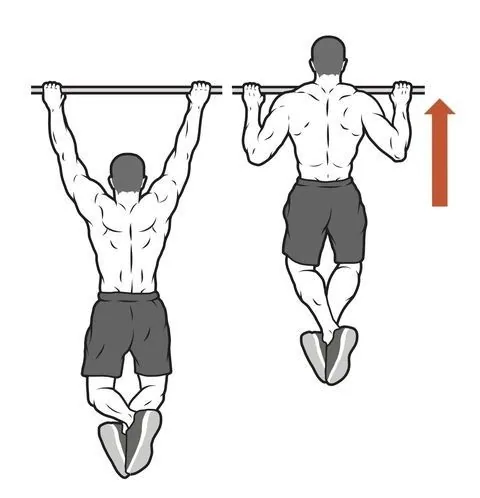
Hang from a bar with a pronated grip, hands shoulder-width apart, and try to pull up. How many complete reps (chin over the bar, arms extended at the bottom) can you do?
- 0 reps → Start at Level A (weeks 1-3)
- 1-4 reps → Start at Level B (weeks 3-5)
- 5-7 reps → Start at Level C (weeks 5-7)
- 8+ reps → Use this program as volume guidance toward 15-20
Take the test rested, not at the end of a back session. A fatigued test drops you into a lower level than you belong in and costs you weeks. If you're between two levels, pick the lower one: having spare strength in week one costs nothing, being under-strength for three straight weeks gets you injured.
If you've never done a single pull-up, start with the ultimate pull-up guide, which breaks down the technique before you jump into a volume plan.
Why 8 Weeks and Not 4
During the first 3-4 weeks of a new program almost all of your improvement is neural: your nervous system learns to recruit more fibers at once and to coordinate lats, biceps and core in the same instant. That's the phase where people jump fast and get excited.
After that, further progress needs new tissue: more muscle cross-section in the lats and biceps, and tendons that tolerate more load. That doesn't happen in days, it happens in weeks. That's why 4-week plans hand you your first rep and then leave you stuck, and why this one runs for 8: the second half is what turns "one pull-up" into "ten pull-ups".
If you've already been stuck at the same number for a while, the problem is rarely the plan — it's how you apply it, as explained in the mistake that stops you from doing more pull-ups.
The 3 Foundation Exercises
1. Negative Pull-Up
Jump to the top position (chin over the bar) and lower yourself as slowly as possible until your arms are fully extended. Target: a 5-8 second descent. It's the number one tool for building pull-up strength when you can't do the full movement yet, because you're 20-40% stronger in the eccentric phase than in the concentric one.
Common mistake: dropping the last 20 cm. That final stretch is exactly what builds dead-hang strength, which is where almost everyone fails.
2. Band-Assisted Pull-Up
An elastic band anchored to the bar reduces the weight you have to lift. Start with the band that lets you do 5-8 reps with perfect technique and reduce the resistance as you improve.
Common mistake: keeping the thick band forever because "more reps come out". The band helps a lot at the bottom and almost nothing at the top, so an over-thick band hides precisely the range you need to train. Drop a band size as soon as you pass 8 clean reps.
3. Australian Row (Bodyweight Row)
Lie under a hip-height bar (or a sturdy table) and pull until your chest touches it. The more horizontal your body, the harder it gets. It works the exact same muscles as the pull-up with less load.
Common mistake: leading with your head instead of your chest. The rep is marked by your sternum, not your chin.
The Program at a Glance
| Block | Weeks | Frequency | Goal of the block |
|---|---|---|---|
| Level A | 1-2 | 3 days/week | Hold the hang and control the descent |
| Level B | 3-4 | 3-4 days/week | Your first unassisted pull-up |
| Level C | 5-6 | 4 days/week | From 1 to 5 reps |
| Level D | 7-8 | 4 days/week | From 5 to 10 reps |
Always leave at least one day between pulling sessions in blocks A and B. In C and D you can run strength day and volume day back to back, because the volume day stays far from failure.
Week-by-Week Program
WEEKS 1-2: Base Building (Level A)
Frequency: 3 days/week with at least one rest day between sessions
Training day:
- Active hang: 3 × 30 seconds (shoulders pulled down)
- Australian rows: 4 × 10 reps
- Negative pull-ups: 5 × 3 reps (5-second descent)
- Hanging scapular retractions: 3 × 10
Goal: negatives lasting 6-8 seconds per rep by the end of week 2.
If you can't hold a 30-second hang, that's fine: do 3 sets of whatever you can hold and add 3-5 seconds per session. The hang is the base of everything; if your hands open before your back tires, your grip is the bottleneck, not your lats.
WEEKS 3-4: First Rep (Level B)
Frequency: 3-4 days/week
Training day:
- Australian rows: 3 × 12
- Thick-band pull-ups: 4 × 6-8 reps
- Slow negatives: 4 × 3 reps (8-second descent)
- Band bicep curls: 3 × 12
Week 4 milestone: attempt your first unassisted pull-up. If it comes out, log it on Reppy — that's your historic moment.
Take the attempt at the start of the session, fresh and after a couple of easy warm-up sets. Trying your first pull-up at the end of a workout is the fastest way to convince yourself, wrongly, that you still can't.
WEEKS 5-6: 1 to 5 Reps (Level C)
Frequency: 4 days/week
Strength Day:
- Pull-ups: 5 sets stopping 1-2 reps short of your max
- Negative pull-ups: 3 × 3 with a 10-second descent
- Backpack-weighted rows: 3 × 8
Volume Day:
- EMOM 10 minutes: 2-3 pull-ups every minute
- Thin-band pull-ups: 3 × 8-10
- Bicep curls: 3 × 15
Here comes the most important rule of the program: you don't train to failure on strength day. Leaving 1-2 reps in reserve on every set lets you accumulate far more weekly volume, and weekly volume is what builds the 10 pull-ups.
WEEKS 7-8: 5 to 10 Reps (Level D)
Frequency: 4 days/week
Strength Day:
- Pull-ups: 6 sets × 3-4 reps (with reserve, not to failure)
- Weighted pull-ups (light backpack): 3 × 3
- Weighted rows: 4 × 6
Volume Day:
- EMOM 15 minutes: 4-5 pull-ups every minute
- Chin-ups (supinated grip): 3 × 6-8
- Hammer curls: 3 × 12
Final test, week 8: after 48h of complete rest, do your max reps. Following the program properly, expect 8-12 reps.
How to Know It's Working (and When to Repeat a Block)
Don't look only at the final number. These are the signs the block is doing its job:
- Your negatives last more seconds with the same technique.
- You finish sets with 1-2 reps of margin instead of grinding.
- The next day your back feels worked — not your elbow or your shoulder.
And these are the signs you should repeat the block instead of moving on: you miss the low end of the prescribed rep range two sessions in a row, you need to kick your legs to get up, or you're carrying soreness that doesn't clear in 72 hours. Repeating two weeks doesn't set you back — it saves you the month you'd lose injured.
The 5 Mistakes That Derail the Program
- Training to failure every day. Constant failure spikes fatigue without adding useful stimulus. It's the number one cause of plateaus.
- Partial range of motion. Half a pull-up is half a result. Arms extended at the bottom, chin clearly over the bar at the top.
- Skipping Australian rows because "they're not real pull-ups". They're what gives you the pulling volume you can't yet handle hanging.
- Switching programs every two weeks. Progressive overload needs continuity; eight weeks of one plan beats four two-week plans.
- Training only pull-ups. With no pushing work (push-ups, dips) you build a shoulder imbalance that ends in pain.
Elbow or Forearm Pain: When to Stop
It's the most common complaint in any pull-up plan, and it almost always shows up between weeks 3 and 6, when volume climbs faster than tendons adapt. The difference between "loaded" and "injured" is simple: load fades as you warm up, injury gets worse with every set.
If it happens, don't grit your teeth through it. Cut pulling volume by 30-50% for a week and review your grip — it's covered in elbow pain from pull-ups and forearm and elbow pain.
What to Do on Rest Days
Rest doesn't mean mandatory couch. On off days you can:
- Grease the Groove: very short sets (half your max) spread across the day, never close to failure. It's the best complement to this program and it's explained in grease the groove.
- Shoulder and wrist mobility: 5 minutes is enough to reach the next session with better range.
- Easy passive hangs: 2 × 20 seconds to decompress and build grip without fatigue.
What you shouldn't do is add another hard pulling session "because I have energy left". The program already counts on those days to rebuild.
The Muscles a Pull-Up Works
To understand why this program works, it helps to know which muscles are involved:
- Latissimus dorsi: the main engine, drives the pull
- Rhomboids and lower traps: stabilize the scapula
- Biceps brachii: secondary engine at the elbow
- Rotator cuff: stabilizes the shoulder
- Core: keeps the body tight and stops the swing
If you fail in the bottom half (from the hang to mid-range), the bottleneck is usually the lats. If you fail at the top (chin over the bar), it's usually biceps and lower traps. Adjust the emphasis of your next block accordingly: more rows and negatives if you fail low, more chin-ups and curls if you fail high.
Nutrition and Recovery
- Protein: 1.6-2.2 g per kg of bodyweight per day (calisthenics nutrition and protein)
- Sleep: 7 hours minimum. Growth hormone is released mostly during deep sleep (sleep for gains)
- Hydration: tendons need water to stay elastic
- Rest between sets: 2-3 minutes on strength day. Cutting it to 45 seconds turns your strength day into a mediocre volume day (rest between sets)
With pull-ups there's an extra factor people forget: bodyweight is load. Dropping 3 kg of fat improves your reps as much as weeks of training, without touching the program. You don't need an aggressive diet; just don't gain weight during the 8 weeks.
Realistic Expectations by Starting Point
| You start with | End of week 8 | Note |
|---|---|---|
| 0 reps | 4-8 reps | The first rep usually lands in week 4-5 |
| 1-4 reps | 8-12 reps | The fastest progress of any profile |
| 5-7 reps | 12-15 reps | Added weight starts to be necessary |
| 8+ reps | 15-20 reps | Prioritize the volume day and light loading |
If you're carrying significant extra weight or coming back from an injury, plan for 10-12 weeks instead of 8. The order of the blocks doesn't change, only the time you spend in each.
Frequently Asked Questions
Can I do it with just a doorway bar? Yes. All three base exercises work with a doorway bar and a band. For Australian rows you can use a sturdy table or a set of low rings.
Chin-ups or pull-ups? Pronated pull-ups for the main work (that's the goal of the program) and chin-ups as an accessory in block D. Chin-ups involve more biceps and produce more reps, so don't use them to measure your progress.
What if I miss a week? Repeat the last week you completed before moving on. One missed week doesn't cost you strength, but it does cost you the rhythm of the progression.
Can I combine it with the gym? Yes, as long as a heavy back day doesn't land right before your pull-up strength day. Leave 48 hours between them.
Does it prepare me for muscle-ups? It's the prerequisite. With 10 strict pull-ups you have the pulling base; from there you work on explosiveness and the transition.
What do I do after the 8 weeks? Pick one of two: more reps (repeat block D raising the EMOM volume) or more strength (start adding 5-10 kg and work in sets of 3-5). Chasing both at once is the classic recipe for a plateau.
Track Your Progress on Reppy
Every rep you do counts. Logging them on Reppy gives you:
- Activity heatmap: spot whether you're consistent or leaving gaps in the program
- STR (Strength) attribute: rises directly with logged pull-ups
- Rankings: once you hit 10 pull-ups, compare your progression with the community
And because Reppy is an RPG, those 8 weeks aren't just a spreadsheet: every set deals real damage to bosses, levels you up and unlocks rewards. It's the difference between "I have to train today" and "I get to level up today". You can see it in the pull-up app.
The 10 pull-ups are there. It's 8 weeks of honest work. Start today.